From Capture to HeARTwork — More Than a Click
February 27, 2026
Before I press the shutter, there’s often a small pause.
A glance at the sky.
A look around the location.
A gentle question from my client:
“Are you sure this is going to work?”
It might be cloudy.
There might be leashes in the frame.
A car parked where we’d prefer it wasn’t.
A setting that feels beautifully ordinary — but not yet extraordinary.
And that’s where the journey begins — not at the click, but in everything that surrounds it.
What you see on your wall is never just the result of a single click. It’s the result of preparation, perspective, and refinement — from the moment of capture through the final brushstroke of finishing.
Let me show you what that looks like.
When the Light Hides (and Trust Steps In)
There was a moment, standing on this bridge, when we almost rescheduled.
The forecast had promised sun.
Instead, the sky delivered gray.
We looked up. We checked radar. We weighed options.
And then I asked them to trust me.
Cloud cover doesn’t ruin portraits. It changes the character of the light. Instead of harsh highlights and deep shadows, we get softness. Evenness. Detail.
Notice how gently the light wraps around their faces here — no squinting, no heavy shadows beneath their eyes. That softness is the gift of an overcast sky.
Sunlight creates drama.
Cloud cover creates dimension.
On this day, dimension won.
What They Shared Afterward
After seeing their finished portraits, they wrote:
“Even though the sun decided to hide on the day of our shoot, Kelly helped us make the best of it, and the results were stunning… She was wonderfully accommodating with our reactive dog… The final portraits turned out better than we could have imagined.”
That trust allowed space for calm, confident moments — especially important with a reactive dog in the mix.
Behind the Scenes
Here’s what the camera originally recorded.
Two dogs who could not comfortably pose shoulder-to-shoulder at the same time.
Leashes.
Handlers just outside the frame.
A public trail that felt beautifully ordinary — but unfinished.
Because one of the dogs is reactive, photographing them simultaneously might have created tension and stress.
Instead, I photographed each dog separately in the same position, under the same light, from the same perspective.
The final portrait is carefully blended from two calm, confident moments.
This approach prioritizes safety and comfort — without compromising the integrity of the finished artwork.
The Refinement
In the finishing process:
- Leashes and handlers were removed.
- The two separate frames were blended seamlessly.
- Tone and contrast were shaped for depth.
- Background elements were simplified.
- Fur detail was refined to preserve natural texture.
- The final image was prepared specifically for print.
What looks effortless here is built on preparation — in-camera decisions, thoughtful blending, and refinement designed to hold beautifully at larger sizes.
Trust creates space for calm expressions.
Preparation preserves them.
And refinement ensures they live well beyond the moment.
But not every transformation requires blending multiple frames or navigating reactive personalities.
Sometimes, the refinement is quieter.
Subtler.
And just as important.
When Real Life Sneaks Into the Frame
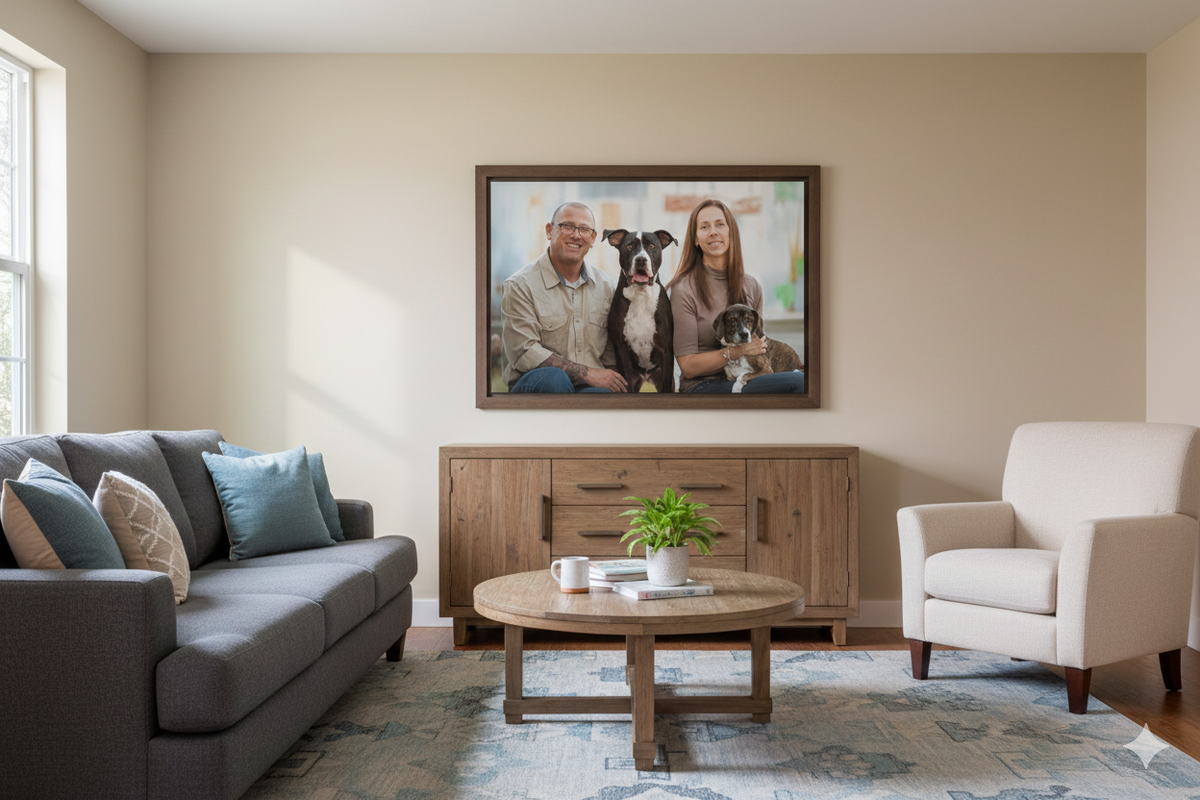
At first glance, this portrait feels effortless.
Two humans.
Two dogs.
A quiet moment of connection.
But what you don’t see in the finished image is just as important as what you do.
Public spaces are rarely pristine.
Cars park where they please.
Poles interrupt clean lines.
Backgrounds compete for attention.
The goal isn’t to find perfection.
It’s to refine it.
Behind the scenes
In the original frame, a vertical pole cut through the composition.
A parked car quietly pulled attention away from the family.
The overall tone leaned cooler and flatter than intended.
Nothing was “wrong.”
But it wasn’t yet worthy of a 20x30 framed canvas.
The Refinement
In the final portrait:
- Visual distractions were carefully removed.
- Background elements were simplified to create visual calm.
- Color temperature was warmed for cohesion and emotional depth.
- Skin tones were balanced.
- The black dog’s fur was refined to preserve detail without losing richness.
- Subtle contrast shaping added dimension without harshness.
Deep fur tones — especially in black-coated dogs — require careful handling. Too much contrast and detail disappears. Too little and the image falls flat.
When a portrait is destined for large-format print, every highlight, shadow, and transition must hold up under close viewing.
Screens are forgiving.
A 20x30 canvas is not. At that scale, every detail matters.
Editing isn’t about altering reality.
It’s about removing what distracts from it.
When visual clutter disappears, connection becomes the focal point.
When tones are unified, the portrait feels intentional.
When details are refined for print, the artwork gains longevity.
And that integrity begins long before it’s framed.
Refinement can simplify what’s already there.
But sometimes, the real artistry begins even earlier — in the ability to recognize potential before anyone else sees it.
Seeing Beyond What's There
This portrait was created on the owner’s property.
A place she sees every day.
And I’m fairly certain that when we set up the shot, she thought I might be slightly… ambitious.
Behind us? A working environment.
Trailers. Hard lines. Practical structures.
Nothing that immediately suggests fine art portrait.
Clients see familiarity.
I see possibility.
That difference changes everything.
Behind the Scenes
The original frame included strong structural lines and functional elements that competed for attention.
Again — nothing was “wrong.”
But it required refinement.
The Transformation
In the finishing process:
- Distracting structural elements were removed.
- The background was simplified and softened.
- Tonal shaping created depth and separation.
- Color grading elevated the mood.
- Subtle adjustments enhanced the Saluki’s natural elegance and form.
What remains is not a fabrication.
It’s a distillation.
The essence of the subject — without the noise.
When I choose a location, I’m not choosing it for what it looks like in that moment.
I’m choosing it for how it will translate once refined.
I consider light direction, separation, perspective, texture, and how the final piece will feel at scale.
The camera records what exists.
An artist anticipates what it can become.